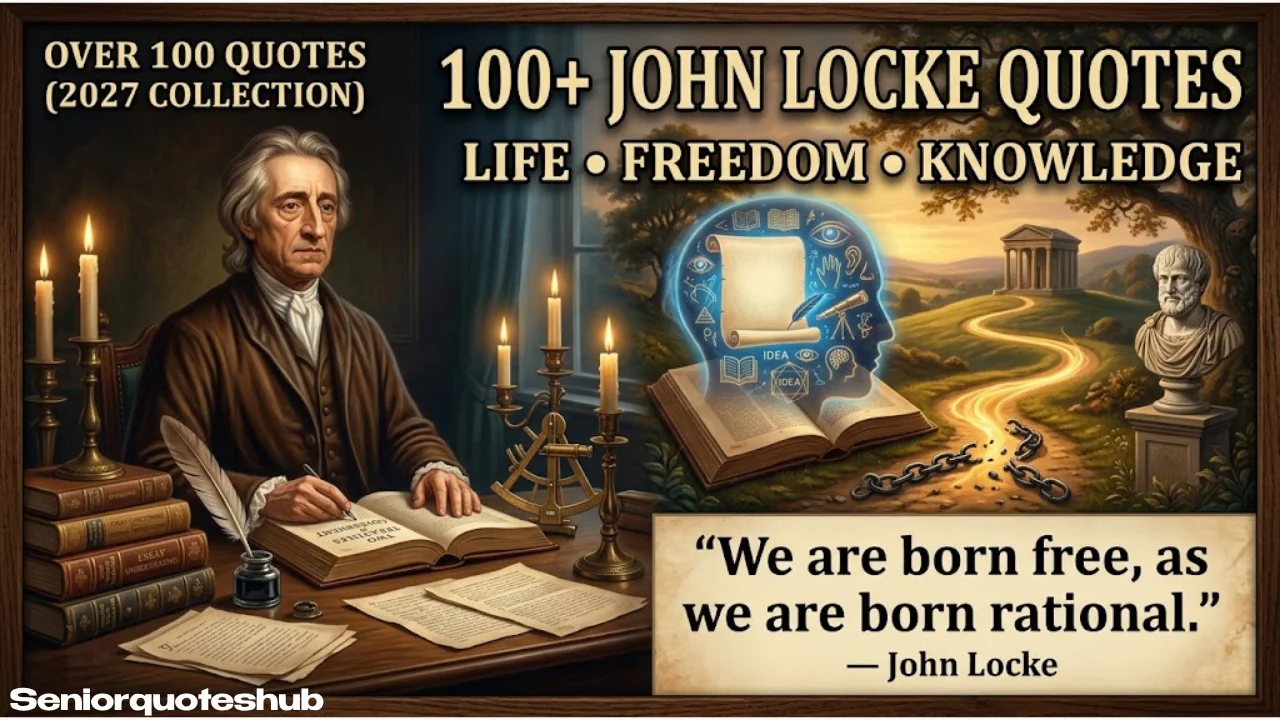
John Locke never planned on becoming the philosopher every constitution quietly borrows from. He trained as a physician, spent years advising a nervous English politician, and only later put his ideas about the mind, government, and human nature into writing. Yet those ideas outlived every empire that ignored them.
This list pulls together John Locke quotes about life, freedom, and knowledge straight from his real books — Two Treatises of Government, An Essay Concerning Human Understanding, Some Thoughts Concerning Education, and A Letter Concerning Toleration. Every quote below comes from a verified source, not a recycled meme caption.
Table of Contents
Who Was John Locke? A Quick Primer Before the Quotes
John Locke (1632–1704) was an English philosopher and physician, often called the Father of Liberalism. He studied medicine at Oxford, worked as a personal physician to the Earl of Shaftesbury, and spent time in political exile in the Netherlands before returning to England after the Glorious Revolution of 1688.
His two biggest ideas still shape modern life. First, the mind at birth is a tabula rasa — a blank slate — and all knowledge comes from experience, not from ideas we’re born with. Second, government only has authority because the people consent to it, and it exists to protect natural rights: life, liberty, and property.
Thomas Jefferson leaned on Locke’s language when drafting the Declaration of Independence. The phrase “life, liberty, and the pursuit of happiness” is Locke’s “life, liberty, and property,” lightly reworded. That’s not a coincidence — it’s a direct line from a 17th-century English study to a founding American document.
With that background, here are his quotes on life, freedom, and knowledge — organized so you can find exactly the kind of wisdom you’re after.
John Locke Quotes About Life
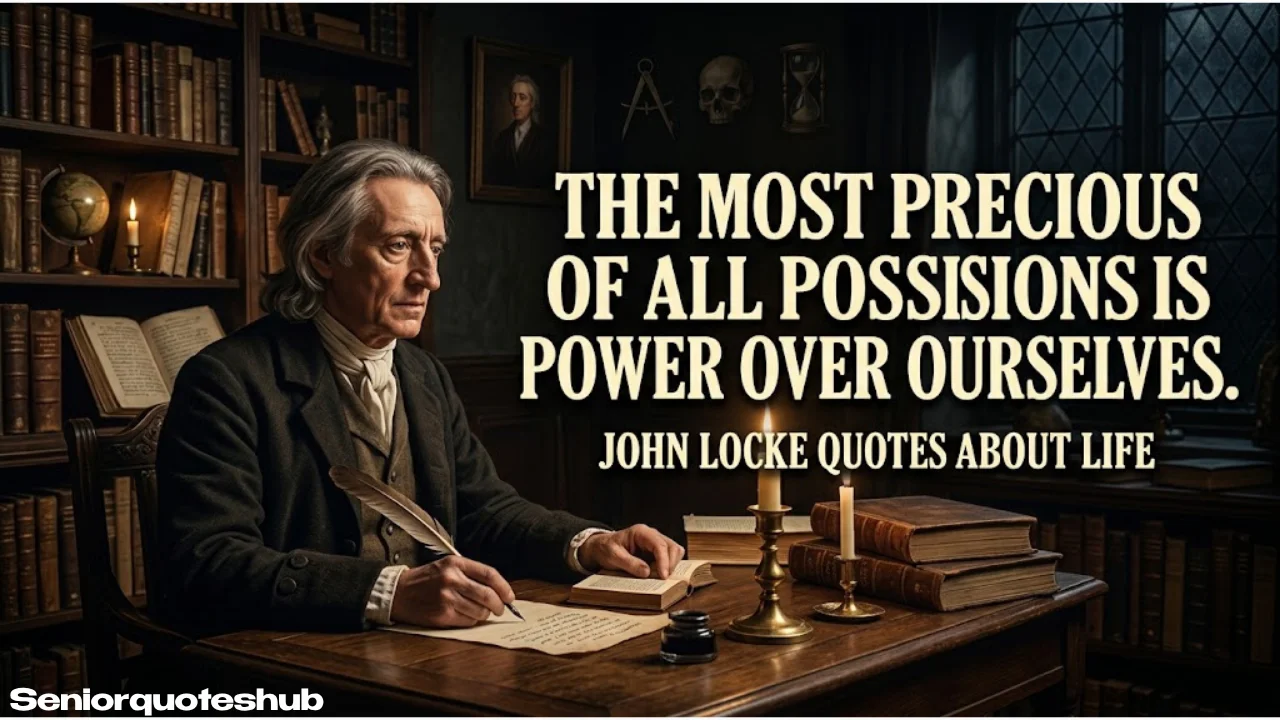
Locke wrote less about “life” as an abstract feeling and more about how people should actually live it — with self-control, honest reflection, and realistic expectations. These lines still read like practical advice, not dusty philosophy.
On self-mastery and happiness
- “The most precious of all possessions is power over ourselves.”
- “A sound mind in a sound body, is a short but full description of a happy state in this world.”
- “Men’s happiness or misery is, for the most part, of their own making.”
- “What worries you, masters you.”
- “Our incomes are like our shoes; if too small, they gall and pinch us; but if too large, they cause us to stumble and to trip.”
- “The dread of evil is a much more forcible principle of human actions than the prospect of good.”
- “Things of this world are in so constant a flux, that nothing remains long in the same state.”
On character and virtue
- “Virtue is harder to be got than knowledge of the world; and, if lost in a young man, is seldom recovered.”
- “We are a kind of chameleons, taking our hue — the hue of our moral character — from those who are about us.”
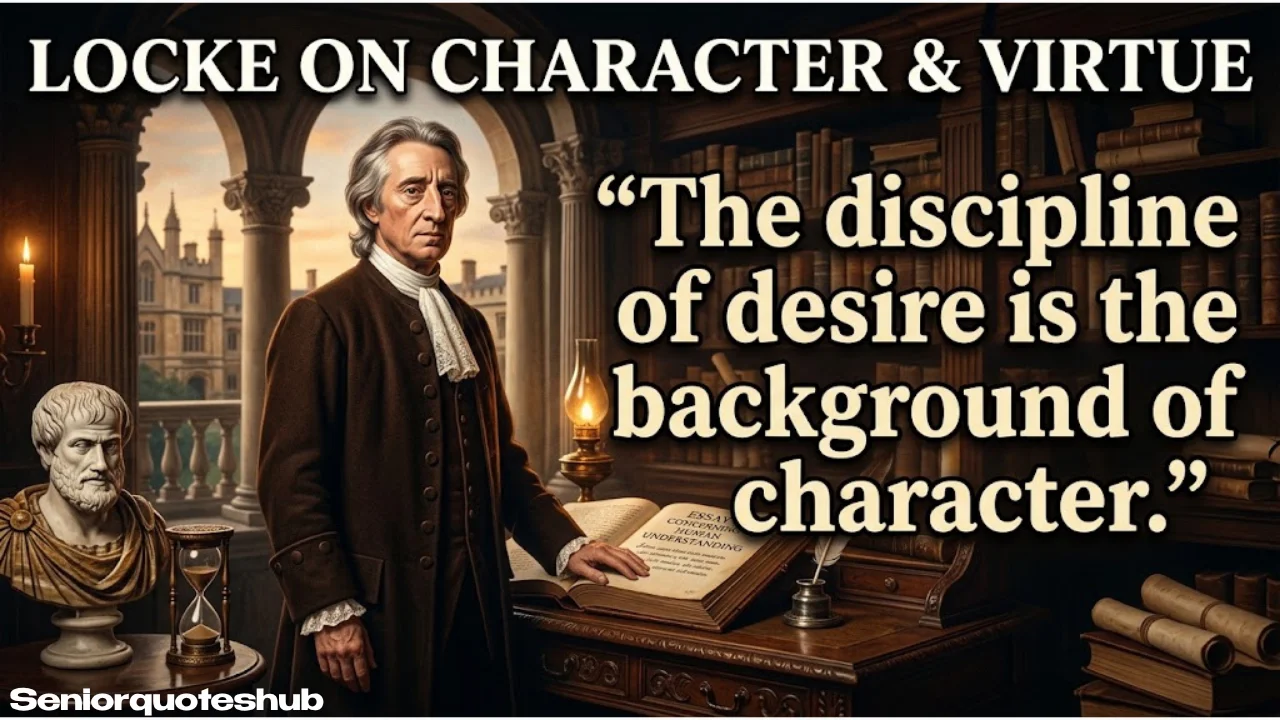
- “The discipline of desire is the background of character.”
- “Who lies for you will lie against you.”
- “To love our neighbor as ourselves is such a truth for regulating human society, that by that alone one might determine all the cases in social morality.”
On honesty and how people reveal themselves
- “I have always thought the actions of men the best interpreters of their thoughts.”
- “The thoughts that come often unsought, and, as it were, drop into the mind, are commonly the most valuable of any we have.”
- “There are a thousand ways to wealth, but only one way to heaven.”
- “Parents wonder why the streams are bitter, when they themselves have poisoned the fountain.”
On effort, poverty, and study
- “He that will not set himself resolutely to study, let him go home and entertain himself with the thoughts of his poverty or weakness; but let him not go to school.”
- “I am sure the principal end why we are to get knowledge here is to make use of it for the benefit of ourselves and others in this world.”
- “He that sinks his vessel by overloading it, though it be with gold and silver and precious stones, will give his owner but an ill account of his voyage.”
On childhood and human nature
- “Curiosity in children is but an appetite for knowledge.”
- “Good and evil, reward and punishment, are the only motives to a rational creature: these are the spur and reins whereby all mankind are set on work, and guided.”
- “Since the great foundation of fear is pain, the way to harden and fortify children against fear and danger is to accustom them to suffer pain.”
- “As children’s inquiries are not to be slighted, so also great care is to be taken that they never receive deceitful and illuding answers.”
- “Let the awe the teacher has upon children’s minds be so tempered with the constant marks of tenderness and good will, that affection may spur them to their duty.”
- “I think I may say that of all the men we meet with, nine parts of ten are what they are, good or evil, useful or not, by their education.”
Must Visit : 11 Powerful Marsha P. Johnson Quotes About Pride, Courage & Equality
John Locke Quotes About Freedom
This is where Locke did his most consequential work. His Two Treatises of Government built the case that people are born free and equal, that governments exist only by consent, and that a ruler who breaks that trust forfeits the right to rule. These ideas fed directly into the American Revolution and the U.S. Constitution.
On natural rights and equality
- “All mankind… being all equal and independent, no one ought to harm another in his life, health, liberty, or possessions.”
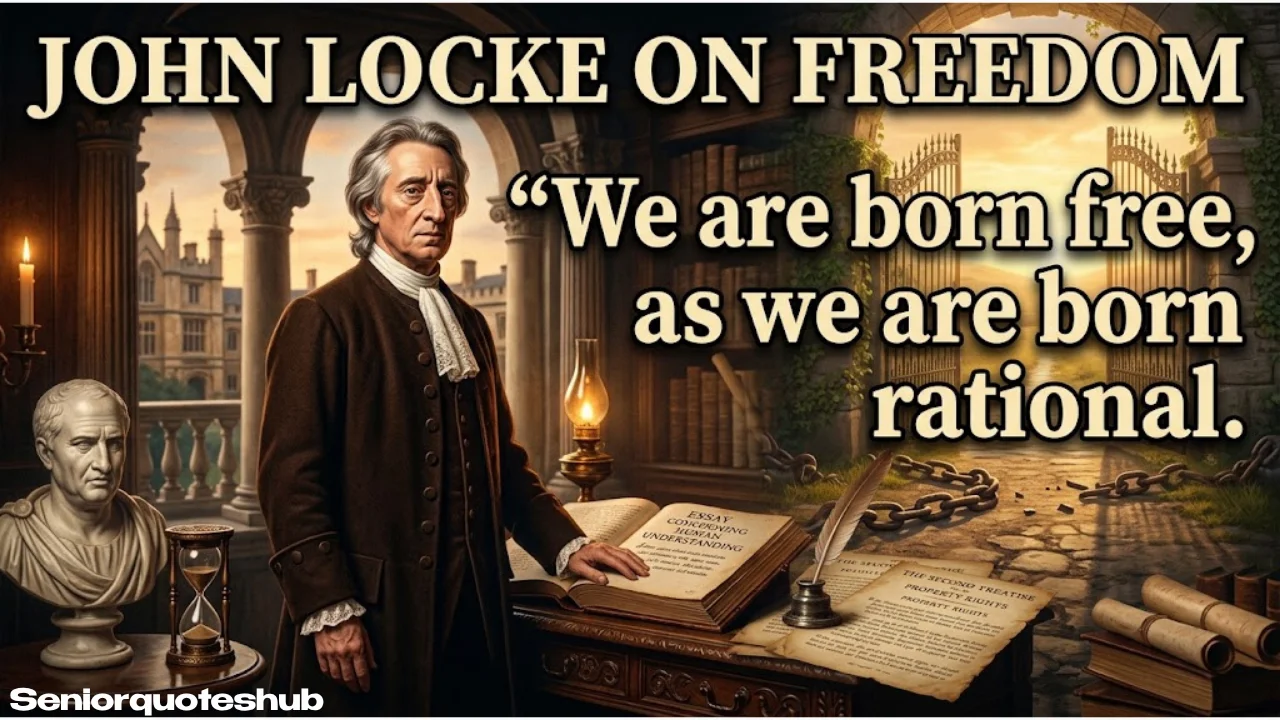
- “We are born free, as we are born rational.”
- “Every man has a property in his own person. This nobody has a right to but himself.”
- “Men being, as has been said, by nature all free, equal and independent, no one can be put out of this estate and subjected to the political power of another without his own consent.”
- “All men by nature are equal in that equal right that every man hath to his natural freedom, without being subjected to the will or authority of any other man.”
- “The state of nature has a law of nature to govern it, which obliges every one: and reason, which is that law, teaches all mankind, who will but consult it, that being all equal and independent, no one ought to harm another in his life, health, liberty, or possessions.”
On what freedom actually means
- “Where there is no law, there is no freedom.”
- “The end of law is not to abolish or restrain, but to preserve and enlarge freedom.”
- “Liberty is to be free from restraint and violence from others.”
- “Freedom of men under government is to have a standing rule to live by, common to every one of that society, and not to be subject to the inconstant, uncertain, arbitrary will of another man.”
- “Every one, as he is bound to preserve himself, and not to quit his station wilfully, so by the like reason, when his own preservation comes not in competition, ought he, as much as he can, to preserve the rest of mankind.”
On government, consent, and its limits
- “Government has no other end but the preservation of property.”
- “The people cannot delegate to government the power to do anything which would be unlawful for them to do themselves.”
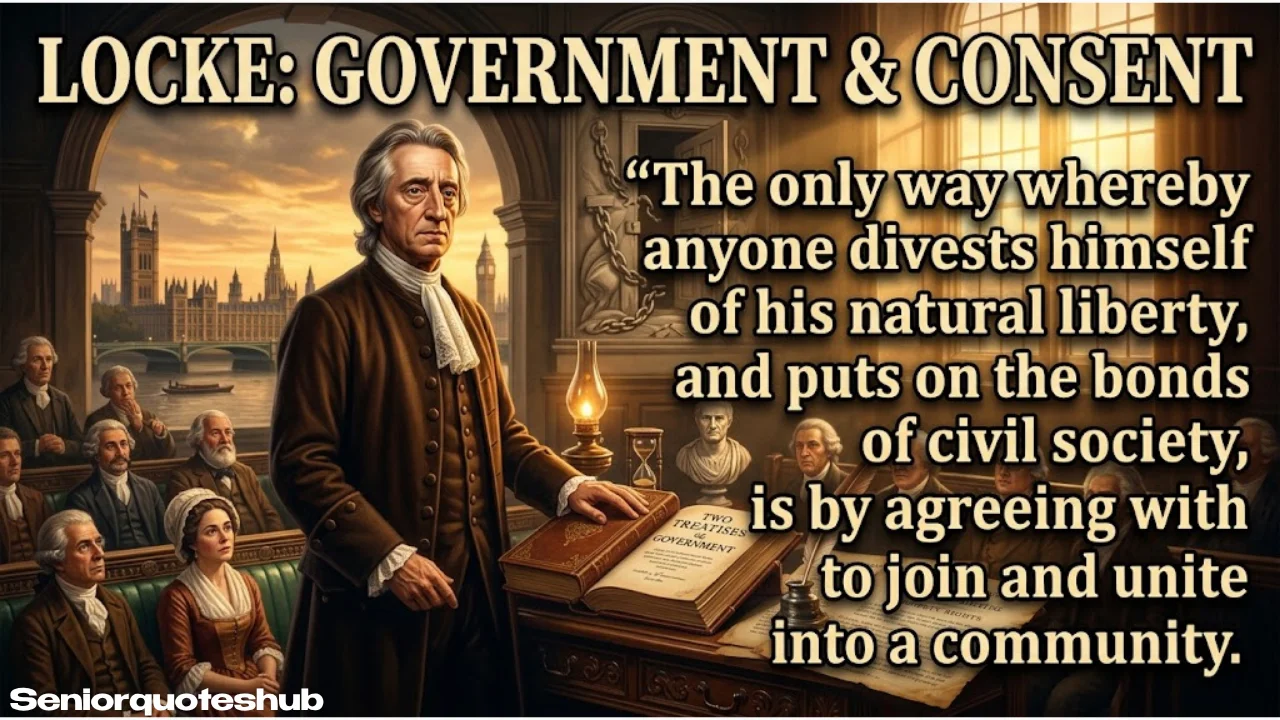
- “The only way whereby anyone divests himself of his natural liberty, and puts on the bonds of civil society, is by agreeing with other men to join and unite into a community.”
- “For the civil government can give no new right to the church, nor the church to the civil government.”
On tyranny and resistance
- “Wherever law ends, tyranny begins.”
- “As usurpation is the exercise of power which another hath a right to, so tyranny is the exercise of power beyond right, which nobody can have a right to.”
- “Whenever legislators endeavor to take away and destroy the property of the people, or to reduce them to slavery under arbitrary power, they put themselves into a state of war with the people, who are thereupon absolved from any further obedience.”
- “I have no reason to suppose that he who would take away my liberty would not, when he had me in his power, take away everything else.”
- “To this I answer: that force is to be opposed to nothing, but to unjust and unlawful force.”
- “Where there is no judge on earth, the appeal lies to God in heaven.”
- “Every man hath a right to punish the offender, and be executioner of the law of nature.”
On property and land
- “Nothing was made by God for man to spoil or destroy.”
- “Land that is left wholly to nature, that has no improvement of pasturage, tillage, or planting, is called, as indeed it is, ‘waste’.”
On religious toleration
- “I esteem that toleration to be the chief characteristic mark of the true Church.”
- “No peace and security among mankind — let alone common friendship — can ever exist as long as people think that governments get their authority from God and that religion is to be propagated by force of arms.”
- “No man can be forced to be rich or healthful whether he will or no. Nay, God Himself will not save men against their wills.”
John Locke Quotes About Knowledge
Locke’s An Essay Concerning Human Understanding took thirteen years to write and permanently changed how philosophers talk about the mind. His central claim: there’s no such thing as innate knowledge. Everything you know, you learned — through your senses, your experience, and your own reflection on both.
On the mind as a blank slate
- “Let us then suppose the mind to be, as we say, white paper, void of all characters, without any ideas.”
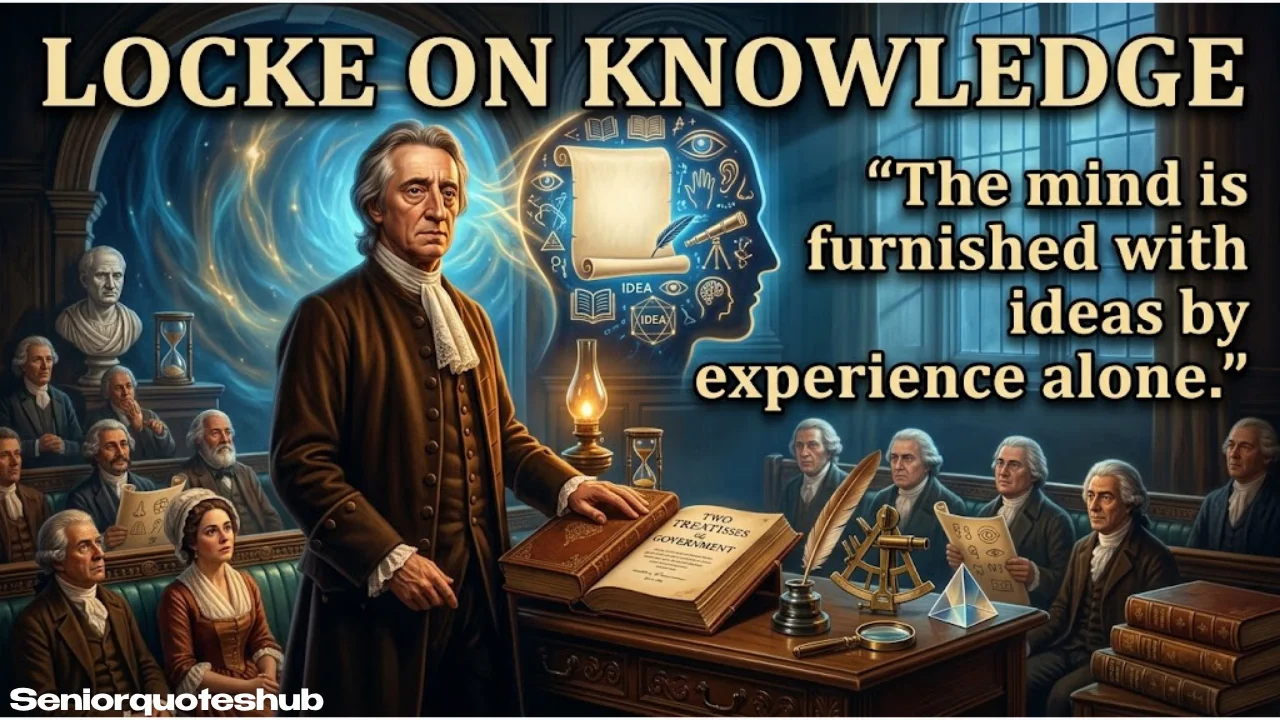
- “The mind is furnished with ideas by experience alone.”
- “No man’s knowledge here can go beyond his experience.”
- “All that is in the intellect proceeds from the senses.”
On reason, truth, and error
- “Reason must be our last judge and guide in everything.”
- “New opinions are always suspected, and usually opposed, without any other reason but because they are not already common.”
- “All men are liable to error; and most men are, in many points, by passion or interest, under temptation to it.”
- “It is one thing to show a man that he is in an error, and another to put him in possession of the truth.”
- “One unerring mark of the love of truth is not entertaining any proposition with greater assurance than the proofs it is built upon will warrant.”
- “To love truth for truth’s sake is the principal part of human perfection in this world, and the seed-plot of all other virtues.”
- “Truth seldom has received, nor does it often receive, much assistance from the power of great men to whom it is not always welcome.”
- “He that judges without informing himself to the utmost that he is capable cannot acquit himself of judging amiss.”
- “Few men think, yet all will have opinions.”
- “Reason is natural revelation, whereby the eternal Father of light, and fountain of all knowledge, communicates to mankind that portion of truth which he has laid within the reach of their natural faculties.”
On reading, thinking, and learning
- “Reading furnishes the mind only with materials of knowledge; it is thinking that makes what we read ours.”
- “The improvement of understanding is for two ends: first, our own increase of knowledge; secondly, to enable us to deliver that knowledge to others.”
- “Education begins the gentleman, but reading, good company, and reflection must finish him.”
- “The only defense against the world is a thorough knowledge of it.”
- “The business of education is not to make a scholar, but to make a man.”
- “Reverie is when ideas float in our mind without reflection or regard of the understanding.”
- “Our business here is not to know all things, but those which concern our conduct.”
- “It is therefore worthwhile to search out the bounds between opinion and knowledge, and examine by what measures, in things whereof we have no certain knowledge, we ought to regulate our assent.”
On rest, distraction, and the discipline of thought
- “Earthly minds, like mud-walls, resist the strongest batteries; and though perhaps sometimes the force of a clear argument may make some impression, yet they nevertheless stand firm and keep out the enemy truth that would captivate or disturb them.”
- “For number applies itself to men, angels, actions, thoughts — everything that either doth exist or can be imagined.”
- “The study of mathematics would show the necessity there is in reasoning to separate all the distinct ideas, and to see the habitudes that all those concerned in the present inquiry have to one another.”
Why John Locke’s Quotes Still Matter Today
John Locke’s quotes on life, freedom, and knowledge aren’t museum pieces. His idea that governments derive their power from the consent of the governed sits at the core of every modern democracy. His argument that all knowledge starts with experience helped launch the scientific method’s turn toward observation over assumption — a shift historians of science still credit as foundational to empiricism. And his writing on education, that “nine parts of ten” of a person’s character comes from how they’re raised, still shows up in modern child-development research on the impact of early environment.
Locke didn’t just leave behind quotable lines. He left behind the intellectual scaffolding for how the United States — and most constitutional democracies since — think about rights, government, and the individual.
FAQs About John Locke Quotes
What is John Locke’s most famous quote?
His most cited line is usually some version of “all mankind… being all equal and independent, no one ought to harm another in his life, health, liberty, or possessions,” from the Second Treatise of Government. It’s the philosophical root of “life, liberty, and property” — and later, Jefferson’s “life, liberty, and the pursuit of happiness.”
What did John Locke say about freedom?
Locke argued that real freedom isn’t the absence of all rules — it’s living under law that everyone agrees to and that protects you from the arbitrary will of another person. His line “where there is no law, there is no freedom” sums up that view directly.
What is John Locke’s theory of knowledge called?
It’s called empiricism. Locke argued the mind starts as a blank slate (tabula rasa) and that every idea we have comes from sensory experience or reflection on that experience — not from ideas we’re born with.
What books did John Locke write?
His major works include Two Treatises of Government (1689), An Essay Concerning Human Understanding (1689), A Letter Concerning Toleration (1689), and Some Thoughts Concerning Education (1693).
How did John Locke influence the U.S. Constitution?
Locke’s ideas about natural rights, government by consent, and the right to resist tyranny directly shaped Thomas Jefferson’s Declaration of Independence and influenced the framers’ thinking during the Constitutional Convention, particularly around limited government and individual rights.
Conclusion
John Locke spent his life arguing that people deserve to think for themselves and govern themselves. His quotes on life, freedom, and knowledge hold up because he wasn’t writing slogans — he was working out, line by line, what it actually takes for a person and a society to be free. Three centuries later, the argument still holds.

Abroy Sheroz is the founder and lead content writer at Senior Quotes Hub, a website dedicated to helping students, parents, and teachers find meaningful words for graduation and senior-year milestones. With a passion for writing and a love for capturing life’s big moments in simple, heartfelt language, Abroy started this platform after struggling to find the right words for his own graduation.