Mary Oliver spent her life watching geese, walking through woods, and writing down what she saw. Her poems turned ordinary moments into lessons about living a meaningful life. Today, her words still show up in classrooms, therapy sessions, and Instagram captions across the USA.
This guide breaks down Mary Oliver’s quotes that inspire a meaningful life by theme, explains what each idea actually means, and points you to where you can read the full poems. No fluff — just the wisdom, organized so you can find what you need fast.
Table of Contents
Mary Oliver Quotes on Living a Meaningful Life
Mary Oliver’s most quoted line comes from her poem “The Summer Day,” where she asks what you intend to do with your “one wild and precious life” (Poetry Foundation, House of Light, 1990). It isn’t really a question about hobbies. It’s a challenge to stop sleepwalking through your days.
Oliver won the Pulitzer Prize in 1984 for American Primitive and the National Book Award in 1992 for New and Selected Poems — two of the highest honors in American poetry.<sup>[1][2]</sup> The New York Times once called her, plainly, America’s best-selling poet.<sup>[3]</sup> That popularity matters here: her quotes about meaning didn’t stay inside literary circles. They spread because regular readers, not just critics, found them useful.
Several of her most-cited lines on purpose come from A Thousand Mornings (2012) and Wild Geese: Selected Poems (2004), where she writes about instructions for living a life: pay attention, be astonished, tell about it (Beacon Press, House of Light). That three-part instruction is often treated as a personal motto by readers because it’s short enough to remember and specific enough to actually follow.
Other frequently shared quotes in this theme cover:
The idea that your life “depends on” learning to hold on and let go, from “In Blackwater Woods” (American Primitive, 1983)
The reminder to ask yourself, each morning, what you plan to do with the time you’ve been given
The warning against simply “having visited” the world instead of living in it, from Blue Horses (2014)
Key takeaway: Oliver’s meaning-of-life quotes work because they’re written as direct commands to the reader, not abstract philosophy.
Nature wasn’t a backdrop in Oliver’s work — it was her main subject. She grew up in Maple Heights, Ohio, and later lived on Cape Cod, where daily walks through marshes and woods became the raw material for most of her poems.<sup>[4]</sup>
Her nature poems return again and again to a small set of images: geese, herons, ponds, sunlight, and grasshoppers. In “Wild Geese,” from the 1986 collection Dream Work, she writes that the world “offers itself” to your imagination, no matter how lonely you feel. That line is one of the most searched Mary Oliver quotes about nature in the US today, largely because it reframes loneliness as something the natural world can answer.
Oliver often described nature encounters as almost religious. Her poem “White Flowers” describes feeling herself dissolve into the line between her own body and the surrounding plants — a recurring theme literary critics call her “porousness” between self and world.<sup>[5]</sup> This idea connects her to the American Transcendentalist tradition of Walt Whitman and Ralph Waldo Emerson, a lineage she openly claimed; she called Whitman “the brother I never had.”<sup>[5]</sup>
Common threads in her nature quotes:
Attention as devotion — treating close observation of a bird or flower as a spiritual act
Impermanence — using seasons and migration as metaphors for mortality
Astonishment — insisting that wonder is available every single day, not just on special occasions
Key takeaway: Oliver’s nature quotes work as daily mindfulness prompts because they describe things readers can actually go outside and see for themselves.
Mary Oliver Quotes on Mindfulness and Paying Attention
Long before “mindfulness” became a wellness buzzword, Oliver was writing about paying attention as a discipline. Her short poem “Praying” tells readers it doesn’t have to be a blue iris — it could be weeds in a vacant lot — as long as you actually pay attention (from Thirst, 2006, Beacon Press).
This theme explains why therapists and mindfulness teachers quote her so often. Her poems don’t ask readers to meditate for an hour. They ask for small, repeatable acts: noticing a bird’s song, standing still in a field, breathing on purpose. In “Have You Ever Tried to Enter the Long Black Branches?” (West Wind, 1997), she asks whether you’re “breathing just a little, and calling it a life” — a direct challenge to autopilot living.
Her most quoted instruction on this theme remains “pay attention, be astonished, tell about it,” which functions almost like a three-step mindfulness practice: notice, feel wonder, then share it with someone else.
Key takeaway: Oliver treated attention itself as the meaningful life — not something you achieve once you’re paying attention, but the practice itself.
Mary Oliver Quotes on Love, Loss, and Letting Go
Oliver’s poems about grief carry weight because they came from real loss. Her partner of more than four decades, photographer and literary agent Molly Malone Cook, died in 2005; Oliver later called her “the light of my life” during her National Book Award speech, one of the rare times she spoke publicly about their relationship.<sup>[6]</sup>
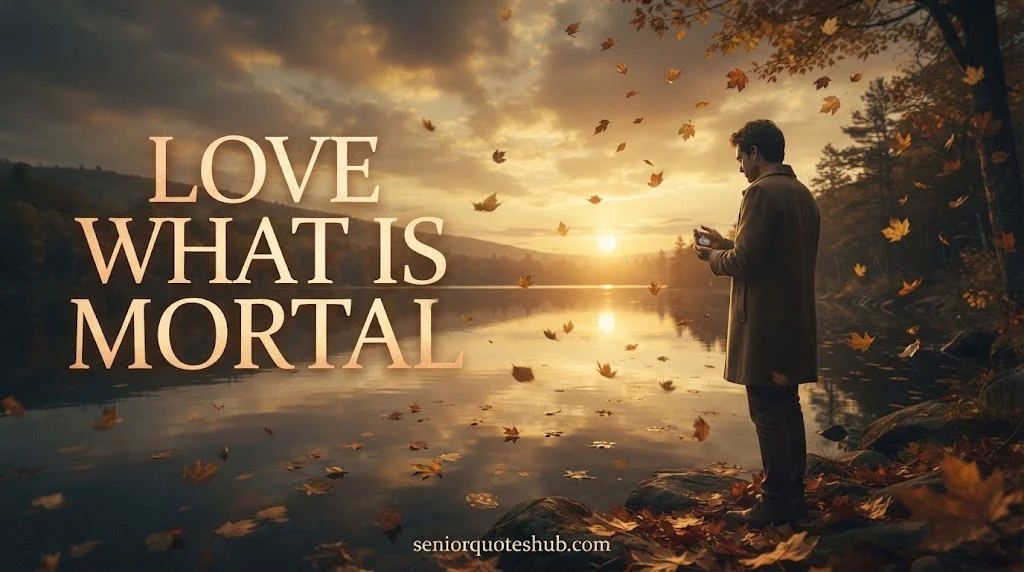
Her poem “In Blackwater Woods” (American Primitive, 1983) lays out what she calls the three requirements for living in this world: loving what is mortal, holding it close, and letting it go when the time comes. It’s one of the most-cited Mary Oliver quotes about loss because it doesn’t try to soften death — it treats letting go as a skill you have to practice.
Elsewhere, she describes grief itself as a kind of gift. In one widely shared line, she says that someone she loved once gave her “a box full of darkness,” and it took years to understand that this, too, was a gift. That reframing — pain as delayed gift — shows up constantly in grief-support content and eulogies across the US.
Oliver died of lymphoma in January 2019 at her home in Hobe Sound, Florida, at age 83.<sup>[3]</sup> Fittingly, many of the quotes readers turn to for comfort after loss are ones she wrote herself, decades before her own death.
Key takeaway: Oliver’s quotes on loss don’t promise the pain will disappear — they promise it can become part of a meaningful life, not a wall against it.
FAQs
What is Mary Oliver’s most famous quote?
Her most famous line asks what you plan to do with your “one wild and precious life,” from the poem “The Summer Day.” It’s the single most searched and shared Mary Oliver quote in the US.
What are Mary Oliver’s quotes about life mostly about?
Most of her life-themed quotes focus on paying attention, feeling wonder, and accepting mortality. She rarely gives abstract advice — her quotes describe specific, small actions like noticing a flower or breathing on purpose.
Which book has the most Mary Oliver quotes about nature?
Dream Work (1986) and American Primitive (1983), her Pulitzer Prize-winning collection, contain many of her most quoted nature poems, including “Wild Geese” and “In Blackwater Woods.”
Why are Mary Oliver’s quotes so widely shared?
Her lines are short, direct, and written in plain language, which makes them easy to remember and quote. She was also one of the best-selling poets in American history, so her work reached far beyond typical poetry readers.<sup>[3]</sup>
Did Mary Oliver write about mindfulness before it became popular?
Yes. Poems like “Praying” and her repeated instruction to “pay attention, be astonished, tell about it” predate the modern mindfulness movement and are now commonly used in mindfulness and therapy contexts.
Conclusion
Mary Oliver’s quotes have lasted because they ask for something simple: notice the world, feel it fully, and don’t waste your one life on autopilot. Whether you’re looking for comfort after loss or a nudge to get outside and pay attention, her words hold up because they were never meant to just be admired — they were meant to be used.
Abroy Sheroz is the founder and lead content writer at Senior Quotes Hub, a website dedicated to helping students, parents, and teachers find meaningful words for graduation and senior-year milestones. With a passion for writing and a love for capturing life’s big moments in simple, heartfelt language, Abroy started this platform after struggling to find the right words for his own graduation.