Finding the best senior auto insurance quotes doesn’t have to feel confusing. Rates, discounts, and rules shift once you hit your 60s and 70s, so this guide breaks down exactly what to expect and how to save in 2026.
Table of Contents
Average Senior Car Insurance Rates by Age in 2026
Your age changes your car insurance rates more than most drivers realize. Here’s what the numbers actually look like.
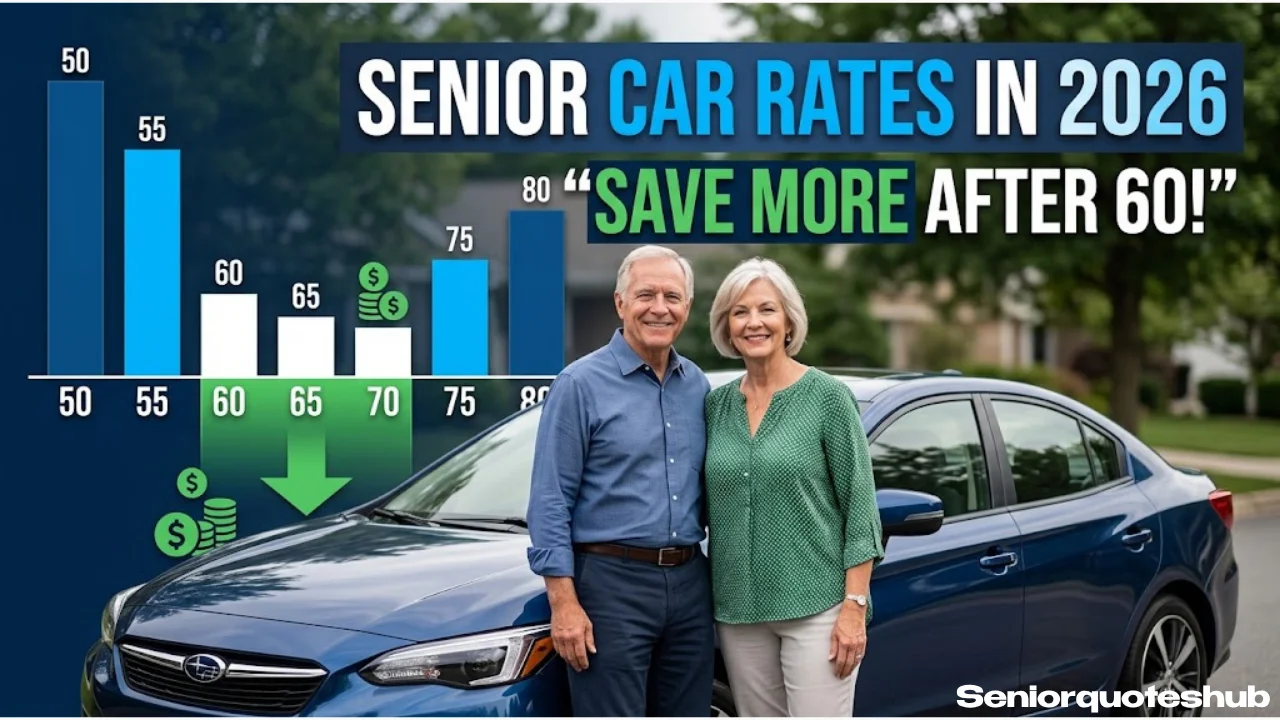
Senior car insurance rates don’t move in a straight line. Drivers in their early 50s typically pay about 6% less than drivers in their late 40s. Rates keep dropping through the mid-60s, then something shifts.
Between ages 55 and 64, drivers often see another 9% decline in premiums. The 65-to-74 age bracket brings a further 5% decrease on average, according to rate data from Progressive. This stretch is usually the cheapest window of a driver’s life.
The trend reverses after age 74. Rates climb back up by roughly 5% once drivers cross into their mid-70s. Other rate analyses put the turning point even earlier, closer to age 65, depending on the state and insurer. So while “senior discount” sounds like a permanent perk, it actually has an expiration window built into it.
Why does this happen? It comes down to actuarial risk, not age discrimination. Reaction time, vision, and hearing can decline gradually, and insurers price policies based on claims data tied to those changes. A clean driving record and low annual mileage can offset a lot of that increase, though, which is exactly why comparing senior auto insurance quotes every year matters more than sticking with one carrier out of habit.
Top Companies Offering the Best Senior Auto Insurance Quotes
Not every insurer treats older drivers the same way, so it pays to know who tends to offer the most competitive senior auto insurance quotes.
Rate comparisons for 70-year-old drivers with a clean record show real gaps between companies. Some large national carriers post average full-coverage rates in the low-to-mid $1,200s to $1,400s per year, while others run noticeably higher for the exact same driver profile, based on a 2024 rate analysis. One large carrier came out cheapest for a senior with an at-fault accident on record, while a different company led the pack for drivers with a spotless history — proof that “cheapest” depends heavily on your personal driving record.
Military-affiliated coverage tends to post the lowest rates overall, but it’s restricted to active-duty members, veterans, and their families. Outside of that, a mix of large national brands and regional carriers regularly trade places at the top of 2026 rankings, which is a good reminder that the “best” company changes year to year.
Semantically related factors that shift your quote include your ZIP code, credit-based insurance score (banned in California, Hawaii, Massachusetts, and Michigan), vehicle safety features, and whether your state requires periodic vision or medical re-certification for older license holders. That last point rarely gets covered, but a handful of states do tie license renewal rules to age, which can indirectly affect how insurers view your risk profile.
How to Compare Senior Auto Insurance Quotes Step by Step
Comparing quotes properly takes a few extra minutes, but it’s the single biggest lever for savings.
Start by pulling quotes from at least three to five insurers, mixing large national names with one or two regional or independent options. Regional insurers are often left out of national rate tables, yet they sometimes beat the big names in specific states.
Next, keep your details consistent across every quote: same coverage limits, same deductible, same annual mileage estimate. Even small mismatches can make one quote look artificially cheaper than it really is.
Ask each insurer directly about mature driver discounts, low-mileage programs, and any telematics or usage-based options. These aren’t always advertised upfront, and an agent won’t always volunteer them unless you ask by name.
Finally, re-shop your policy every 12 months, ideally a month or two before renewal. Loyalty rarely earns a lower rate on its own — insurers adjust pricing models constantly, and last year’s best deal isn’t guaranteed to still be the best deal this year.
Discounts and Programs That Lower Senior Auto Insurance Quotes
Several discounts are built specifically with older drivers in mind, and stacking a few of them can meaningfully cut your premium.
Defensive driving course discounts are the most common starting point. Completing a state-approved mature driver course typically shaves 5% to 15% off your premium, and some states legally require insurers to offer this discount to qualifying age groups. Courses usually run 6 to 8 hours and can be completed online.
Low-mileage and usage-based programs fit naturally into retirement. If you’re driving less than you used to, a telematics app that tracks actual mileage and driving habits can unlock savings that a standard policy won’t capture. This is one of the more underused options for retirees who’ve cut back on commuting.
Bundling policies — combining auto with home, renters, or life insurance — regularly saves 10% to 20% when placed with one insurer. Multi-vehicle discounts apply the same logic if your household still runs two cars.
A few less-discussed options are worth asking about directly: membership-based organizations sometimes offer companion auto discounts for policyholders age 55 and older, and vehicles equipped with advanced safety technology (automatic emergency braking, lane-assist, backup cameras) can qualify for separate equipment-based discounts. Loyalty and paperless billing discounts are smaller, but they add up when combined with the bigger levers above.
FAQs
Do senior auto insurance quotes go up after a certain age?
Yes. Rates generally drop through your 50s and 60s, then begin climbing again somewhere between age 65 and 75, depending on the insurer and state.
What is the average cost of car insurance for seniors in 2026?
Full coverage for a 70-year-old driver with a clean record typically falls in the $1,200 to $1,900 per year range, though your exact rate depends on location, vehicle, and driving history.
Can insurers deny coverage just because a driver is a senior?
No. Insurers can’t deny coverage based on age alone. Coverage can be denied or priced higher for high-risk factors like multiple violations or at-fault accidents, but age by itself isn’t a legal reason for denial.
Is it worth switching insurers as a senior driver?
Often, yes. Rates and discount structures vary enough between companies that re-shopping annually can uncover real savings, especially since loyalty discounts rarely outweigh a better base rate elsewhere.
Do mature driver courses actually lower premiums?
In most states, yes. Completing an approved course typically earns a 5% to 15% discount, and several states require insurers to honor it for qualifying drivers.
Conclusion
Senior auto insurance quotes aren’t one-size-fits-all, and the cheapest option changes based on your age, driving record, and state. The smartest move is simple: compare quotes annually, ask directly about mature driver and low-mileage discounts, and never assume last year’s rate is still your best deal.
Abroy Sheroz is the founder and lead content writer at Senior Quotes Hub, a website dedicated to helping students, parents, and teachers find meaningful words for graduation and senior-year milestones. With a passion for writing and a love for capturing life’s big moments in simple, heartfelt language, Abroy started this platform after struggling to find the right words for his own graduation.